

 Reviewed by
Albany Nursing Home Abuse Lawyer
If Your Loved One Was Injured in an Albany Nursing Home, Our Nursing Home Abuse Attorneys Can Help
Albany nursing home abuse and neglect is inexcusable. All residents at a nursing home deserve appropriate medical care, adequate supervision and protection from preventable injuries. If you believe a family member has suffered from abuse or neglect at a Capital District nursing home, call the Albany nursing home abuse lawyers at Senior Justice Law Firm. We can help your family get answers and justice for your loved one’s suffering.
Nursing home abuse is our law firm’s focus. Representing injured patients is our passion. This is all that we do.
Call Senior Justice Law Firm at 518-861-9266 now for a free Albany nursing home case consultation.
Visit or Call
Our Albany, NY Office
69 State St, Suite 1329
Albany, NY 12207

What We Do
A preventable bedsore, fall, infection or unexplained injury may indicate that an Albany nursing home failed to provide the care its resident required.
Senior Justice Law Firm represents residents and families in nursing home abuse, neglect and wrongful death cases throughout Albany County and New York’s Capital Region.
Our attorneys investigate whether understaffing, inadequate supervision, ignored changes in condition, medication errors or failures to follow a resident’s care plan contributed to the injury. We examine the medical chart, care plans, staffing records, incident reports, wound documentation, hospital records and the facility’s regulatory history to determine what happened and who may be responsible.
Elder Abuse & Neglect in Albany is All Too Common

It is difficult to ascertain how many vulnerable residents of nursing homes are assaulted, abused and neglected. While some abuse is clear, often neglect can be hidden from plain view and can go unreported due to a number of factors. In fact, according to the National Council on Aging, it is estimated that only 1 in 24 cases of elder abuse get reported. Sadly, these shocking statistics will likely continue as baby boomers age and Medicare and Medicaid funding continues to be cut.
While each Albany nursing home is required to comply with state and federal law to ensure safe, comprehensive care for residents, many owners focus on profits over people. The significant number of nursing homes in Albany and throughout New York makes regulatory oversight challenging. Government inspections are important, but regulators may not identify every instance of inadequate care. If you believe a loved one suffered neglect or abuse at an Albany long term care facility, bringing a lawsuit may be the only way to ensure justice for your loved one, and to help prevent similar neglect from happening to other vulnerable residents.
Suspect Abuse or Neglect in an Albany Nursing Home?
If you suspect that your loved one has suffered abuse or neglect under the care of a facility in Albany, you deserve justice. Contact us today for a free consultation.
What is Nursing Home Abuse and Neglect?
Nursing home abuse and neglect occurs when a resident is intentionally mistreated or does not receive the care, treatment or supervision required for their safety and well-being. Abuse involves intentional conduct, such as hitting, threatening or sexually assaulting a resident. Neglect generally involves a failure to provide necessary care, whether caused by individual errors, inadequate training, poor communication, insufficient staffing or management failures.
Nursing home abuse and neglect is arguably more reprehensible than abuse and neglect to average people, because nursing home residents are, by definition, vulnerable. Some residents are unable to move on their own to address their needs. Others require extensive assistance due to their physical limitations. Some residents have dementia or other cognitive impairments that make it difficult to recognize danger, report mistreatment or advocate for themselves. In situations where these residents are harmed, help must come from the outside, including through family members hiring a nursing home abuse lawyer.
Common Forms of Nursing Home Abuse in Albany Facilities
Nursing home abuse and neglect can come in many forms. In general, if nursing home staff are not treating your loved one appropriately, they are abusing or neglecting them. With that said, there are common types of abuse and neglect that repeatedly occur at Albany nursing homes.
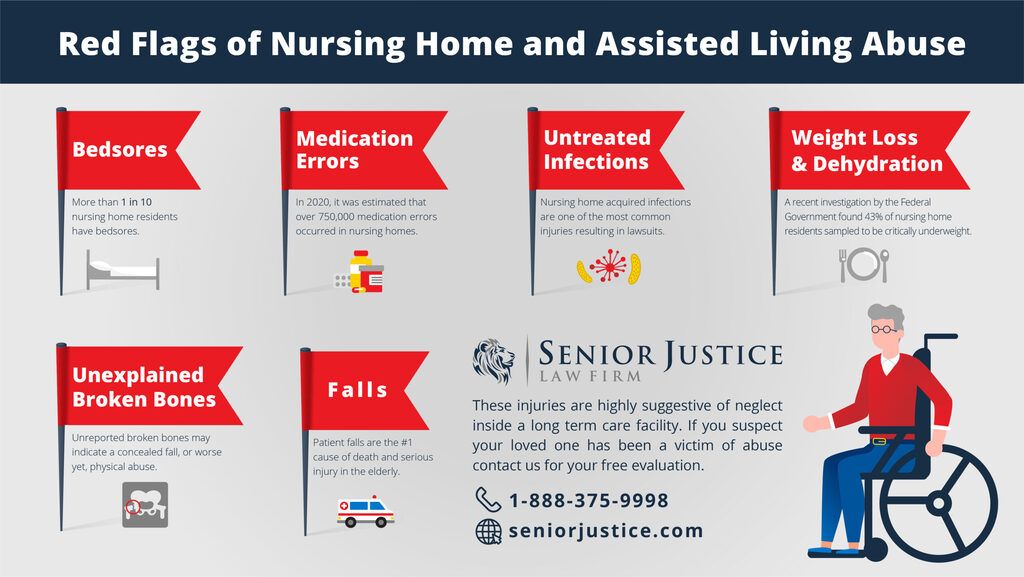
- Bedsores – bedsores occur when there is prolonged pressure on an area of skin. Residents with limited mobility may be at increased risk for pressure injuries, particularly over the sacrum, heels, hips and other bony areas. The facility should assess each resident’s risk and implement individualized interventions involving repositioning, pressure offloading, skin inspection, moisture management, nutrition and appropriate support surfaces. A pressure injury does not automatically prove negligence, but it warrants investigation when the facility failed to recognize the risk, follow the care plan or respond as the wound worsened. Advanced pressure injuries can expose deeper tissue and contribute to osteomyelitis, sepsis and other serious complications.
- Falls – falls occur with alarming frequency at nursing homes. Falls are a major source of injury among nursing home residents and can cause fractures, head trauma, functional decline and death. While it is true that some falls are not preventable, many falls can and should be prevented from occurring. When a resident is admitted to a nursing home, he or she will be assessed for fall risk. This assessment should be rechecked with any change in mental or physical ability during a stay. If a resident is a known fall risk, and the facility is not putting into place common sense, affordable fall precautions, they may be at fault for the resulting injuries. For example, if a resident is known to fall out of bed, or try to wander out of a chair, the facility may consider preventative measures like bed alarms and chair alarms, a lowered bed, fall mats and a toileting schedule.
- Malnutrition/dehydration – residents are sometimes unable to feed themselves due to mental or physical limitations. Staff members are required to provide residents the appropriate food, especially accommodating for special diets. Sometimes overworked staff fails to ensure residents are eating or drinking enough, leading to severe malnutrition or dehydration. Further, some residents are on tube feeding, and need total assistance with their nutrition. If staff fails to properly tube feed, this can lead to choking, infections or even death.
- Choking/aspiration pneumonia – many residents at long term care facilities have swallowing issues. Some have specific diets, such as a pureed diet, while others are NPO (meaning nothing by mouth). It is important that staff ensures residents get the right food to meet their specialized diets. Sadly, overworked staff makes mistakes and may provide the wrong food to the wrong resident, leading to choking or aspiration (where the food goes down the wrong pipe). If this happens, aspiration pneumonia can develop, which can be deadly in elderly vulnerable residents.
- Physical abuse – Physical abuse may be committed by an employee, contractor, visitor or another resident. Facilities must take reasonable measures to protect residents from known risks, investigate allegations promptly and report suspected abuse as required.
- Sexual abuse – shocking as it may seem, sexual abuse does occur at nursing homes. Sexual abuse can be committed by employees, contractors, visitors or other residents. Facilities must appropriately screen covered prospective employees, supervise residents and respond to known risks. Any allegation of sexual abuse should be treated seriously and reported promptly.
- Unexplained fractures – because residents may have difficulty communicating, and because staff members may cover up mistakes, sometimes a resident will have unexplained injuries. If a loved one has a fracture or broken bone, especially a sturdy bone such as a femur, this can suggest an unreported fall or injury.
- Subdural hematomas/brain bleeds – if a resident hits their head, they may develop a subdural hematoma, also known as a brain bleed. These brain hemorrhage injuries can affect mental status or lead to death.
An adverse outcome does not automatically establish negligence. A lawyer must compare the resident’s condition, risks, care plan and treatment with what the facility actually did. Let our narrowly focused and highly specialized elder abuse attorneys and experts analyze your case to see if injury was caused by nursing home negligence.
Warning Signs of Albany Nursing Home Abuse & Neglect
You should always be on the lookout for signs of abuse and neglect when visiting your loved one in a nursing home. The following are some red flags that should alert you to potential abuse and neglect occurring at a facility:
- A lack of staff (especially understaffing on weekends)
- Skin breakdown and pressure ulcers
- Slow responses to call bells/inability to get help when needed
- Unexplained bruises
- Falls
- Significant changes in behavior
- Noticeable weight gain
- Noticeable weight loss
- New bandages in areas with no previous wounds
- Unclean rooms
- Broken A/C or Heating Units
- Complaints from other families
- Withdrawn personality or unresponsive residents
What Damages Are Available in Albany Nursing Home Negligence Lawsuits?
Damages in a nursing home case can fall into two categories: compensatory and punitive.
Compensatory damages are supposed to “compensate” the injured party to make them whole.
Obviously, this is never enough to bring back the loss of a loved one, but this is a jury’s answer to how much an injury is worth.
Compensatory damages include items such as:
- Pain and suffering
- physical disfigurement
- loss of consortium
- loss of capacity (both physical and mental)
- loss of enjoyment of life
- emotional distress
- medical bills (both past and future)
- loss of earnings (both past and future)
- funeral costs (if a wrongful death case)
Punitive damages are reserved for exceptional cases. Under New York common law, they generally require conduct demonstrating willful or wanton wrongdoing, flagrant recklessness or a high degree of moral culpability. Public Health Law §2801-d also permits punitive damages when a deprivation of a nursing home resident’s rights was willful or in reckless disregard of those rights.
Albany Nursing Homes
The following skilled nursing facilities appeared in the New York State Department of Health Nursing Home Profile dataset for Albany County when this page was reviewed in September 2026.
The list is informational.
Inclusion does not mean that a facility committed abuse or neglect, and licensing status should be rechecked through the state database because facilities may close, change names or change operators. Check official state listings for updated information.
| Albany Nursing Home | Address |
|---|---|
| St. Margaret’s Center | 27 Hackett Boulevard, Albany, NY 12208 |
| Hudson Park Rehabilitation and Nursing Center | 325 Northern Boulevard, Albany, NY 12204 |
| Daughters of Sarah Nursing Center | 180 Washington Avenue Extension, Albany, NY 12203 |
| Teresian House Nursing Home Co., Inc. | 200 Washington Avenue Extension, Albany, NY 12203 |
| Shaker Place Rehabilitation and Nursing Center | 780 Albany Shaker Road, Albany, NY 12211 |
| Delmar Center for Rehabilitation and Nursing | 125 Rockefeller Road, Delmar, NY 12054 |
| The Grand Rehabilitation and Nursing at Guilderland | 428 State Route 146, Altamont, NY 12009 |
| Eddy Village Green | 421 West Columbia Street, Cohoes, NY 12047 |
| Our Lady of Mercy Life Center | 2 Mercycare Lane, Guilderland, NY 12084 |
| Eddy Village Green at Beverwyck | 40 Autumn Drive, Slingerlands, NY 12159 |
Albany Nursing Home News

St. Margaret’s Center Settlement and Federal Monitoring
In February 2026, the New York Attorney General and the U.S. Attorney’s Office for the Northern District of New York announced a $1.3 million settlement involving St. Margaret’s Center, an Albany pediatric skilled nursing facility. According to the government announcements, the investigation concerned care provided from 2018 through 2023, including allegations involving staffing, supervision, medication administration and respiratory care. The operator admitted specified wrongdoing under the settlement and agreed to five years of federal monitoring. These were government findings concerning that matter; they do not establish that every adverse outcome at the facility resulted from neglect.
St. Peter’s Nursing and Rehabilitation Center Closure
In March 2026, St. Peter’s Health Partners announced that the 301 Hackett Boulevard facility closed after residents completed transfers. The organization cited the need for approximately $60 million in infrastructure and modernization work and stated that the New York State Department of Health had approved its closure plan.
Albany Center Closure
The Albany Center for Independent Living, an assisted living facility, was shut down by the Town of Bethlehem, citing the building as ‘unsafe for occupancy.’
Nursing Home Negligence Legal Standards and Staffing Requirements
New York nursing home residents are protected by state and federal laws governing safety, dignity, adequate care, freedom from abuse and the right to participate in treatment decisions.
New York Public Health Law §2801-d permits an injured nursing home resident—or, in an appropriate case, the resident’s legal representative or estate—to seek damages when a residential health care facility deprives the resident of a legally protected right or benefit. The law recognizes physical harm, emotional harm, death and financial loss as potential injuries. It also permits punitive damages when a deprivation was willful or in reckless disregard of the resident’s rights. New York Public Health Law §2801-d
Depending on the facts, a case may also include claims for negligence, medical malpractice, wrongful death or conscious pain and suffering.
New York nursing homes are generally required to provide at least 3.5 hours of nursing care per resident per day, calculated over the course of a month. The regulation includes minimum components for registered nurse or licensed practical nurse care and certified nurse aide care. Facilities must also maintain sufficient nursing staff to provide the care each resident requires.
The numerical minimum does not decide every case. A facility can meet an average staffing calculation and still fail a particular resident, while a staffing shortfall does not by itself establish that it caused a specific injury. Staffing records become especially important when the chart shows missed turning, unanswered call lights, inadequate feeding assistance, delayed medication or failure to monitor a change in condition.
Report Nursing Home Abuse in Albany, New York
There are ample ways you can report elder abuse in the Capital district. The State of New York’s Department of Health has a robust investigatory wing which investigates and audits skilled nursing facilities. To learn more, click the link on How to Report New York Nursing Home Abuse.
How Senior Justice Law Firm Investigates an Albany Nursing Home Negligence Case
Our investigation may include:
- The resident’s complete nursing home chart and hospital records
- Admission assessments and care plans
- Fall risk, skin risk and nutrition assessments
- Medication administration records
- Treatment records and wound measurements
- Call light and electronic medical record audit data
- Staffing schedules and payroll based staffing information
- Incident reports and witness statements
- Surveillance footage, photographs and family communications
- New York Department of Health inspection and complaint records
- The roles of the licensee, management company, property owner and related entities
Frequently Asked Questions About Albany Nursing Home Abuse Cases
How long do I have to sue an Albany nursing home?
The deadline depends on the claims and defendants involved. New York generally allows three years for negligence causing personal injury, two years and six months for medical malpractice, and two years from death for wrongful death. Claims involving a public facility may have much shorter notice requirements. Families should not assume that the longest deadline applies. New York Courts limitations table
What compensation is available in a nursing home case?
Recoverable damages may include medical expenses, pain and suffering, emotional harm, disability and other losses caused by the injury. If the resident died, the estate may also pursue legally available survival and wrongful death damages. Punitive damages may be available in exceptional cases involving willful conduct or reckless disregard for residents’ rights.
Who may be liable for nursing home neglect?
Potential defendants can include the licensed facility operator, management company, staffing company, medical providers and other entities whose conduct contributed to the injury. Ownership alone does not necessarily establish liability. The corporate and operational relationships should be investigated using licensing records, contracts and corporate filings.
Should we report suspected nursing home abuse?
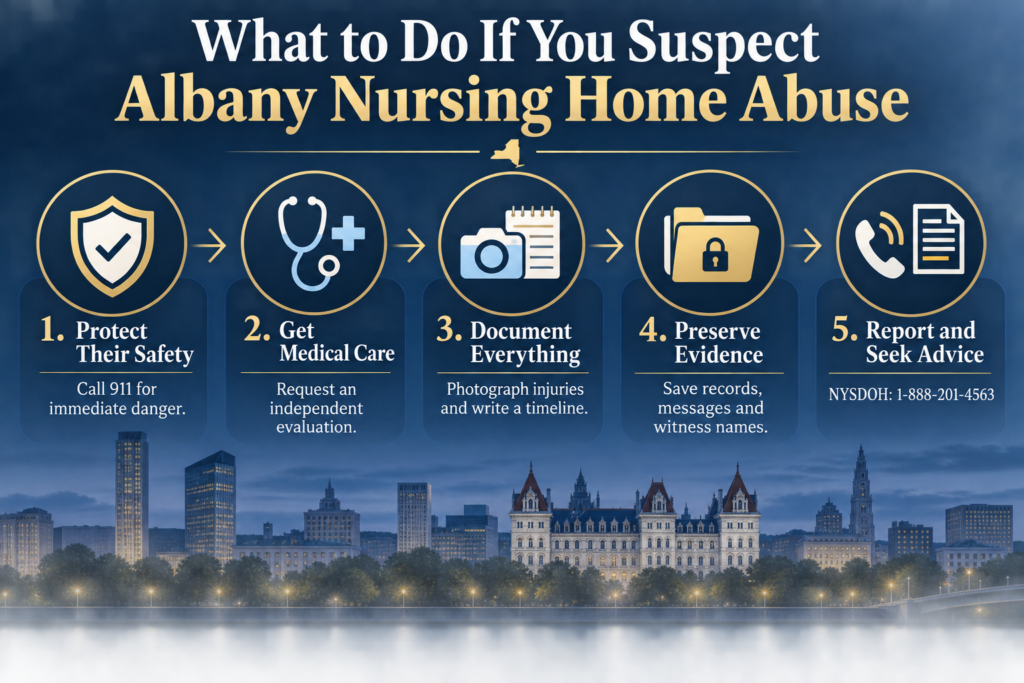
Yes. Immediate danger should be reported to 911. Nursing home care complaints may also be submitted to the New York State Department of Health. Its Nursing Home Complaint Hotline is 1-888-201-4563. New York Department of Health complaint information
The New York Attorney General’s Medicaid Fraud Control Unit also accepts reports involving resident abuse, neglect, infection control violations and Medicaid fraud. Attorney General nursing home complaint form
Does filing a government complaint start a lawsuit?
No. A regulatory complaint may prompt an investigation, but the agency does not become the resident’s private attorney, file a damages lawsuit for the family or necessarily preserve the civil statute of limitations.
What evidence should a family preserve?
Preserve photographs and videos, names of witnesses, text messages and emails, hospital discharge records, bills, clothing or personal items related to the event, and a written timeline of what the family observed. Request the resident’s records promptly and ask in writing that surveillance footage and electronic data be preserved.
Can a nursing home arbitration agreement affect the case?
Potentially. Facilities sometimes rely on arbitration provisions contained in admission documents. Whether an agreement is enforceable can depend on who signed it, the signer’s authority, the language used and the circumstances surrounding admission. A family should have the documents reviewed before accepting the facility’s assertion that arbitration is mandatory.
Can we obtain Albany nursing home inspection records?
Yes. New York’s Nursing Home Profiles system publishes ownership, inspection, complaint and enforcement information. CMS Care Compare also provides staffing and quality information for Medicare certified nursing homes. New York Nursing Home Profiles and CMS nursing home resources
This page was reviewed and approved by New York nursing home abuse attorney David Brevda.
Free Attorney Consultation for Albany Nursing Home Negligence Case
If you believe you may have a case against a nursing home in Albany, NY or the Capital District region, contact Senior Justice Law Firm now for a completely free case consultation.
We handle nursing home abuse cases on a contingency-fee basis, meaning you pay no upfront attorney’s fees. The written representation agreement explains responsibility for litigation costs and expenses.
Nursing home abuse is our firm focus. We are experienced, compassionate and knowledgeable. Let our legal team assist you following a serious injury inside an Albany area skilled nursing facility.
Call, chat or submit your information below to begin the conversation. 518-861-9266
